Oil Rises as Iran Says Two Tankers Hit Mines in the Strait of Hormuz; OPEC+ Likely to Roll Over Output Targets at Sunday Meeting
Brent crude rose $1.64, or 1.73%, to $96.25 a barrel on Nov. 26 after Iran's Revolutionary Guards said two tankers struck sea mines near Oman's Khasab port, Reuters reported, while sources said OPEC+ is likely to keep output targets unchanged for at least the first quarter of 2027 at its Nov. 29 meeting; there is no WTI settlement because of Thanksgiving.
Oil prices reversed early losses to trade higher on Thursday, Nov. 26, 2026, after Iran's Revolutionary Guards said two tankers hit sea mines in the Strait of Hormuz, adding to supply concerns a day after Yemen's Houthis said they attacked Saudi Arabia's largest refinery. Trading was thin because of the U.S. Thanksgiving holiday, and investors were also looking ahead to a meeting of OPEC+ ministers on Sunday, Nov. 29.
Brent climbs toward the top of its recent range
Brent crude futures were up $1.64, or 1.73%, at $96.25 a barrel in the afternoon in Europe, and U.S. West Texas Intermediate crude rose $1.10, or 1.31%, to $84.78, Reuters reported in a story carried by RTÉ. Earlier, at 0923 GMT (4:23 a.m. ET), Brent had been down 96 cents at $93.65, according to a Reuters report published by Euronext. Around 11:52 a.m. ET, January WTI futures were at $84.61, up 1.11% from Wednesday's settlement of $83.68, after trading between $83.16 and $85.23, according to Yahoo Finance data.
There will be no WTI settlement on Thursday because of the holiday. On Wednesday, Brent settled up $3.21, or 3.51%, at $94.61, and WTI gained $1.63, or 1.99%, according to EnergyNow, citing Reuters. EnergyNow noted that the January Brent contract expires on Nov. 30, so some continuous futures charts may already show the lower-priced February contract.
"The perceived supply surplus in the coming months and quarters and sticky inflation, which forces central banks to raise rates, resulting in a stronger dollar, will possibly set a ceiling on any attempt to push prices significantly higher," PVM Oil Associates analyst Tamas Varga said, according to Reuters. "The new trading range, it appears, is around $88-$97, basis Brent."
Mine strikes reported in the Strait of Hormuz
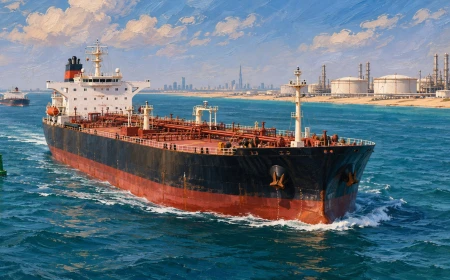
Iran's Revolutionary Guards said on Thursday that two tankers exploded and caught fire after hitting sea mines north of Oman's Khasab port while attempting to cross the Strait of Hormuz through an unauthorized route, Reuters reported via Arab News. One of the vessels was a supertanker carrying more than 2 million barrels of crude, according to the Guards' statement carried by the semi-official Tasnim news agency. The vessels were not identified.
The United Kingdom Maritime Trade Operations agency separately reported an explosion caused by an unknown projectile near a tanker about 50 nautical miles west of Dubai on Thursday, Reuters said. Revolutionary Guards spokesman Hossein Mohebbi said the force was using heavy firepower to keep the strait closed, according to Iranian state media. Reuters noted that maritime security agencies often describe such incidents as strikes by unknown projectiles and that their reports do not always match the Guards' accounts.
"The broadening of the Middle East conflict threatens to halt the recovery in oil flows," ANZ analyst Daniel Hynes said. Morgan Stanley analysts estimated last week's Middle East crude exports, including routes that bypass Hormuz, at 15.3 million barrels per day, Reuters reported. Saudi Arabia's government and Aramco did not immediately respond to requests for comment on the Houthi claim about the Ras Tanura refinery, which is part of a complex that also serves as a major crude export terminal.
OPEC+ likely to hold output targets
OPEC+ is likely to keep its oil output targets unchanged for at least the first quarter of 2027 at Sunday's meeting, two people with knowledge of the talks told Reuters, as reported by Dawn. The group had planned to use its first-ever review of members' production capacity to help set 2027 quotas, but disagreements from some countries appear to have made that more difficult, the report said. Reuters said the group must also balance output with the United Arab Emirates no longer a member, while some members, including Iraq, are pressing for higher capacity estimates.
In a note published Thursday, MUFG commodities analyst Edward Bell said production from OPEC+ members that rely on the Strait of Hormuz for exports was still 1.8 million barrels per day below target levels as of October, while Oman, which exports outside the strait, had exceeded its quota by an average of 89,000 barrels per day per month this year. Bell estimated about 3.6 million barrels per day of capacity could return to the market if members keep existing baseline estimates. MUFG forecast Brent averaging $88.75 a barrel in 2027, down from $93 in 2026, and WTI averaging $83.75 versus $86.60 this year.
Refinery outages and other energy markets
Thailand's Bangchak Corp said it had shut all production units at its Phra Khanong refinery in Bangkok after a fire, and a drone attack caused a fire and serious damage at the Slavyansk ECO refinery in Russia's Krasnodar region, Reuters reported. In the United States, crude inventories rose 1.1 million barrels to 418.9 million barrels in the week ended Nov. 20, less than the 1.5 million-barrel increase analysts expected, the Energy Information Administration said on Wednesday.
Elsewhere, U.S. natural gas futures fell 1.56% to $3.601 per million British thermal units and Comex copper rose 0.31% to $5.4385 a pound around 11:52 a.m. ET, Yahoo Finance data showed. Dutch TTF gas, Europe's benchmark, was about €87.6 per megawatt-hour, up 0.3%, according to Il Sole 24 Ore. U.S. stock markets reopen on Friday, Nov. 27, and close early at 1 p.m. ET, according to the NYSE.
What's Your Reaction?
 Like
0
 Dislike
0
 Love
0
 Funny
0
 Wow
0
 Sad
0
 Angry
0

Curated by iShook Opinion and guided by Founder and CEO Beni E Rachmanov. Dive into valuable financial insights at ishookfinance.com for expert articles and latest news on finance.













Comments (0)