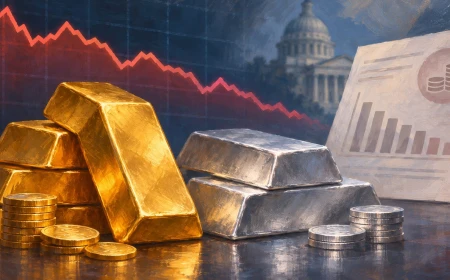
Gold Jumps More Than 4% Toward $3,670 and Silver Surges Nearly 6% as Precious Metals Rebound From Last Week's Rout
December Comex gold was at $3,667.70 an ounce around 11:56 a.m. ET on Nov. 23, up 4.33%, and December silver was at $43.44, up 5.77%, as bargain buying and a broad risk-on rally lifted metals after last week's steep losses; platinum rose 2.71%.
Gold and silver prices rebounded sharply on Monday, Nov. 23, 2026, recovering part of last week's heavy losses as investors returned to assets that had been sold during a broad market selloff.
December gold futures on Comex were at $3,667.70 an ounce around 11:56 a.m. ET, up $152.30, or 4.33%, from Friday's settlement of $3,515.40, according to Yahoo Finance data. The contract traded between $3,552.30 and $3,691.00 during the session. The February contract was at $3,697.90, up 4.34%.
Spot gold figures also showed a large gain. Spot gold last traded at $3,668.20 an ounce, up more than 3% on the day, Kitco News reported. Bloomberg said spot gold was 3.5% higher at $3,660.63 as of 2:13 p.m. in London, after rising as much as 3.6%, according to The Business Times. At 9 a.m. ET, spot gold was $3,657.14 an ounce, compared with $3,571.30 at the same time Friday, CNBC Select reported.
Silver, platinum and palladium
December silver futures were at $43.44 an ounce around 11:56 a.m. ET, up $2.37, or 5.77%, from Friday's settlement of $41.07, according to Yahoo Finance. Bloomberg reported spot silver up 5.6% at $42.46 earlier in the day, after a drop of almost 16% last week. BullionVault reported that silver rose 1.3% to $42.91 in Asian trading, gave back half of that gain after London opened and then rose above $44 at the start of New York trading.
Platinum futures were at $1,324.30 an ounce, up 2.71%, and palladium was at $898.00, up 0.71%, around the same time, Yahoo Finance data showed.
A rebound after a steep slide
Gold fell nearly 9% last week to its lowest level in more than a year, according to Bloomberg. Bloomberg said the metal has fallen by around a third since the U.S.-Iran war began in late February, as higher energy costs fueled inflation and prompted central banks to raise interest rates, and that gold dropped below $4,000 this month as investors sold holdings to cover losses elsewhere.
From Oct. 30 to Nov. 20, gold and the S&P 500 each fell 8.8%, the Nasdaq Composite lost 11.1%, silver and copper each fell 15.4% and bitcoin dropped 23.8%, BullionVault said, citing analysis by Nicky Shiels, head of precious metals strategy at MKS Pamp. "Gold is often called an ATM, and it was among the first assets sold to raise cash," Jeff Toshima, a former Tokyo director of the World Gold Council, told BullionVault.
Much of the recent selling in gold appears to have been in futures, while exchange-traded fund holdings have remained "remarkably steady," UBS analyst Joni Teves wrote in a note cited by Bloomberg. Shops in Shenzhen's Shuibei market, the center of China's retail gold trade, were crowded with buyers of jewelry, said Song Jiangzhen, a researcher at the Guangzhou Southern Gold Market Academy, according to Bloomberg.
Data, the dollar and the Fed
The gold market showed little reaction to U.S. economic data on Monday, Kitco said. S&P Global's flash composite PMI fell to 54.6 in November from 55.9, its manufacturing PMI fell to 54.5 from 54.9, and its services PMI fell to 54.7 from 56.1, below forecasts of 55.6. "The survey price gauges remain at levels consistent with inflation running well above the Fed's 2% target in the coming months, despite some moderation of the rate of inflation in November," said Chris Williamson, chief business economist at S&P Global Market Intelligence.
Interest-rate traders were pricing a 96% chance of a quarter-point Fed rate increase at the December meeting at the start of New York trading, BullionVault reported. Later in the morning, Reuters reported that fed funds futures fully priced such an increase, and that the dollar index was up 0.41% at 104.27. A stronger dollar makes dollar-priced metals more expensive for buyers using other currencies. Treasury Secretary Scott Bessent warned on Sunday that the Fed risks harming the economy by tightening too much, according to Bloomberg and BullionVault.
The October personal consumption expenditures price index, the Fed's preferred inflation gauge, is due Wednesday, Nov. 25, along with jobless claims and new home sales. U.S. markets will be closed Thursday for Thanksgiving. Prices cited above are from late morning and can change before settlement.
What's Your Reaction?
 Like
0
 Dislike
0
 Love
0
 Funny
0
 Wow
0
 Sad
0
 Angry
0

Curated by iShook Opinion and guided by Founder and CEO Beni E Rachmanov. Dive into valuable financial insights at ishookfinance.com for expert articles and latest news on finance.













Comments (0)