













































Rivian Launches $2,500 Autonomy+ Upgrade and New AI Chip for Next-Gen Self-Driving
Rivian introduced its $2,500 Autonomy+ self-driving upgrade, a custom AI chip, and a new in-car assistant as part of its Autonomy and AI Day, with features arriving in 2026.
Key Points
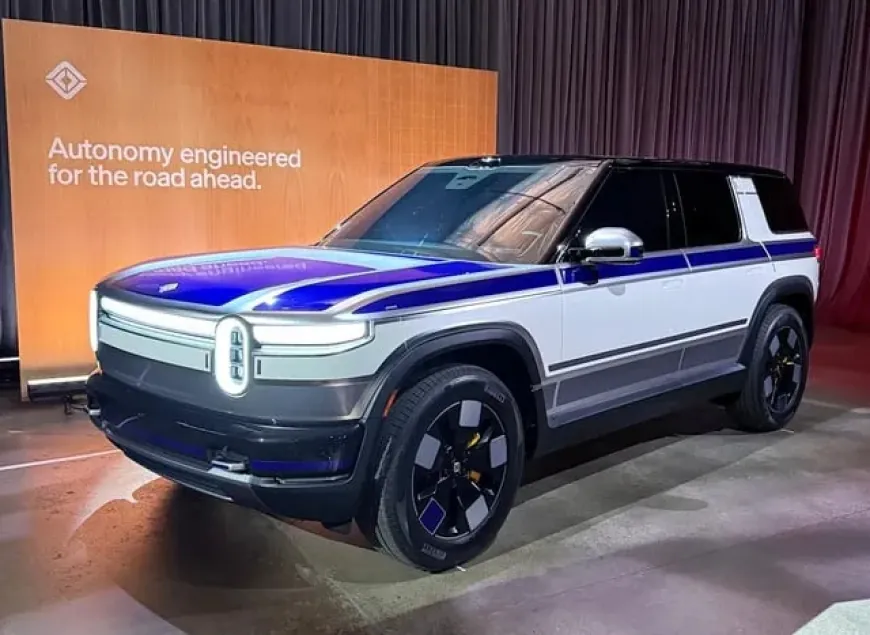
Rivian used its first Autonomy & AI Day to give a detailed look at the software and hardware that will guide its next generation of self-driving and in-car technology. The electric-vehicle maker announced a paid upgrade for advanced assisted driving, revealed its first in-house processor, and introduced a new voice assistant built on its own software platform.
The moves come as competition in driver-assistance technology continues to intensify, and as Rivian tries to set itself apart with a system built entirely around its own tools.
Rivian’s stock dropped more than 6% during the day.
Autonomy+ Brings Hands-Free Driving to Second-Gen R1 Models
Rivian’s new Autonomy+ upgrade will offer hands-free driving on supported roads, backed by a new autonomous driving model the company calls its Large Driving Model (LDM).
The company said LDM is trained in a way similar to large language models, but focused entirely on driving behavior instead of text.
Autonomy+ will be available in early 2026 and priced at:
-
$2,500 one-time, or
-
$49.99 per month
Rivian’s current cars offer adaptive cruise control and lane-keeping, but the new system is designed to handle more complex driving scenarios. The company says this updated platform is the foundation for its long-term goal of reaching Level 4 automation—where a vehicle can drive itself within approved areas.
CEO RJ Scaringe described a future where a Rivian vehicle could be told to drive itself to pick up a child from school, without a driver in the car. The company did not set a date for Level 4 capabilities.
Rivian Builds Its Own 5nm Processor to Power Future Autonomy
Rivian also introduced its first custom processor, following a strategy used by Tesla and other companies building advanced driver-assistance systems.
The Rivian Autonomy Processor (RAP1):
-
Uses a 5nm manufacturing process
-
Combines processing and memory in one module
-
Will run on Rivian’s Autonomy Compute Module 3 (ACM3)
RAP1 is at the center of Rivian’s next hardware platform. Rivian said the system is now undergoing validation and scheduled to appear in its R2 models toward the end of 2026. Early R2 units, expected in the first half of 2026, will use current-generation hardware until ACM3 is ready.
Rivian also confirmed that lidar will be added to upcoming R2 vehicles, giving them a detailed 3D view of the road. This is a key difference from Tesla, which relies entirely on cameras.
Rivian’s New Voice Assistant Arrives in 2026
Alongside its self-driving upgrades, Rivian introduced Rivian Unified Intelligence (RUI)—its new AI platform that will support software tools inside future vehicles.
The first product built on RUI is the Rivian Assistant, a voice-controlled helper that can:
-
Answer questions
-
Help schedule tasks
-
Coordinate with apps such as Google Calendar
-
Assist with service and maintenance planning
The assistant will launch in early 2026 on both Gen 1 and Gen 2 R1 vehicles.
Rivian stressed that its platform is model-agnostic, meaning it can work with various large-model systems, including Google’s Gemini or OpenAI’s ChatGPT. Until now, Rivian used Amazon Alexa for simple commands, but RUI allows the company to run a much wider set of features.
Why Rivian Is Building Its Own Systems
Rivian said it is developing its own processors, driving models, and software so its vehicles can rely less on outside suppliers. By controlling more of the technology inside its cars, the company aims to update features more quickly and match competing systems already on the market. Rivian said this approach will guide the next stages of hands-free driving and its long-term work on higher levels of automation.
Also Read: Rivian Introduces Affordable SUVs and Crossovers in EV Market Revamp