Black Friday Online Spending Jumps 12.8% to $9.7 Billion by Early Evening, Topping Adobe's Forecast, as Store Traffic Lags and Inflation Lifts Prices
U.S. Black Friday online spending reached $9.7 billion through 6:30 p.m. ET on Nov. 27, up 12.8% from a year earlier, and Adobe expects a final total of $13 billion to $13.4 billion, above its $12.9 billion forecast, while Passby data showed store visits running 2.4% below last year.

U.S. shoppers spent $9.7 billion online on Black Friday, Nov. 27, 2026, through 6:30 p.m. ET, up 12.8% from a year earlier, according to Adobe Analytics figures reported by Reuters, putting the day on course to beat the forecast Adobe issued in September. Adobe expects the final Black Friday total to land between $13 billion and $13.4 billion. In physical stores, foot traffic trailed last year's level, according to geospatial data cited by Reuters.
What Adobe and Salesforce reported
In its Sept. 28 holiday forecast, Adobe projected Black Friday online spending of $12.9 billion, an increase of 9.2% year over year. The new range of $13 billion to $13.4 billion would exceed that forecast, Investing.com noted. Adobe also said consumers spent $7.1 billion online on Thanksgiving Day, up 10.4% from last year, according to Reuters, compared with the $6.9 billion, or 8.5% growth, it had forecast in September.
Adobe projects Saturday online spending of $6.1 billion, up 6%, and Sunday spending of $6.4 billion, up 7.5%. Cyber Monday, Nov. 30, is forecast to remain the season's biggest online shopping day at $15.1 billion, up 6.2%, which Adobe has said would make it the first single day to top $15 billion in U.S. online spending. Across the five days from Thanksgiving through Cyber Monday, Adobe expects online sales to rise 7.4% to $47.5 billion, representing 17.3% of its full-season forecast.
Separate data from Salesforce showed U.S. online sales of $5.9 billion in the first half of Black Friday, up 2.9% from a year earlier, and $30.7 billion globally, Reuters reported. Salesforce projects full-day U.S. online spending of $18.7 billion, up 4%, and global spending of $83 billion, up 5.2%. The two companies' figures are built from different data sets and are not directly comparable; Adobe says its analysis is based on direct online transactions at U.S. retail sites.
Mixed traffic in stores
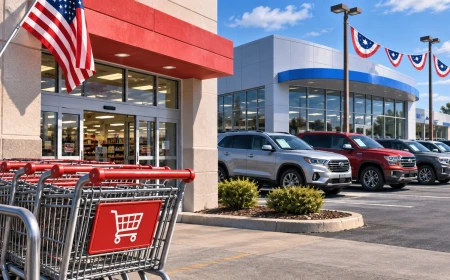
U.S. store visits were tracking 2.4% behind last year's pace, at 760 million, a little after 6:30 p.m. ET, according to Passby, a geospatial analytics company that measures real-time foot traffic, Reuters reported. Results varied by retailer: Best Buy visits were running 3.2% above last Black Friday in the late afternoon, visits to Walmart and Target were slightly higher, and traffic at Lego stores was up more than 5% in mid-afternoon compared with the same time a year earlier, according to the Passby figures.
"Traffic levels in general seemed off compared to past holidays and seemed to lose steam early," Michael Brown, Americas retail leader at consulting firm Kearney, told Reuters after visiting several stores in Westchester County, New York. Target gave $100 gift cards to the first 100 people in line at each store, and one recipient received a $1,000 card, according to Reuters.
Inflation shapes the season
Holiday spending is expected to top last year's results by 4% to 6%, but most of the gains will be attributable to inflation, which at 3.8% is about a percentage point higher than in each of the previous two years, Reuters reported. The National Retail Federation forecasts November-December holiday retail sales will rise 4.2% from a year earlier to just above $1 trillion, and an NRF survey in November found that 82% of consumers are taking steps to manage holiday costs, such as buying less expensive gifts.
Toy prices, which are sensitive to the cost of oil-derived plastics, have risen 13.2% since the start of the year, Reuters reported, and Mattel cut its annual forecast this month as consumers balked at higher prices. Best Buy and Target have both pointed to trading cards, including Pokemon and Magic: The Gathering products, as a key growth driver.
Most holiday spending forecasts were issued before the stock market correction that followed this month's midterm elections, Reuters noted. UBS analysts said in a note on Tuesday that the decline in stock prices could dampen the wealth effect that has supported spending by affluent shoppers.
The full-season outlook
For the full holiday period from Nov. 1 to Dec. 31, Adobe forecast in September that U.S. online sales would reach a record $275.1 billion, up 6.7% from 2025. It projected electronics sales of $63.3 billion and apparel sales of $51.3 billion, with faster growth expected in grocery, at $26.1 billion, up 10.3%, and furniture, at $33.4 billion, up 7.3%. Adobe also expected buy now, pay later services to account for $21.3 billion of online spending in November and December, up 6.6%, and mobile devices to account for 57.4% of the season's online spending.
Amazon shares gained about 4% in Friday's shortened stock market session, which ended at 1 p.m. ET, CNBC reported. U.S. markets are closed on Saturday and reopen Monday, Nov. 30, the same day as Cyber Monday.
What's Your Reaction?
 Like
0
 Dislike
0
 Love
0
 Funny
0
 Wow
0
 Sad
0
 Angry
0

Curated by iShook Opinion and guided by Founder and CEO Beni E Rachmanov. Dive into valuable financial insights at ishookfinance.com for expert articles and latest news on finance.












Comments (0)