
China's October Retail Sales, Factory Output and Investment All Miss Forecasts as Property Slump Deepens
China's retail sales rose just 0.4% in October and industrial output 4.8%, both below forecasts, while fixed-asset investment fell 8.1% in Jan-Oct as property investment slid 21.6%, official data showed Nov. 16.
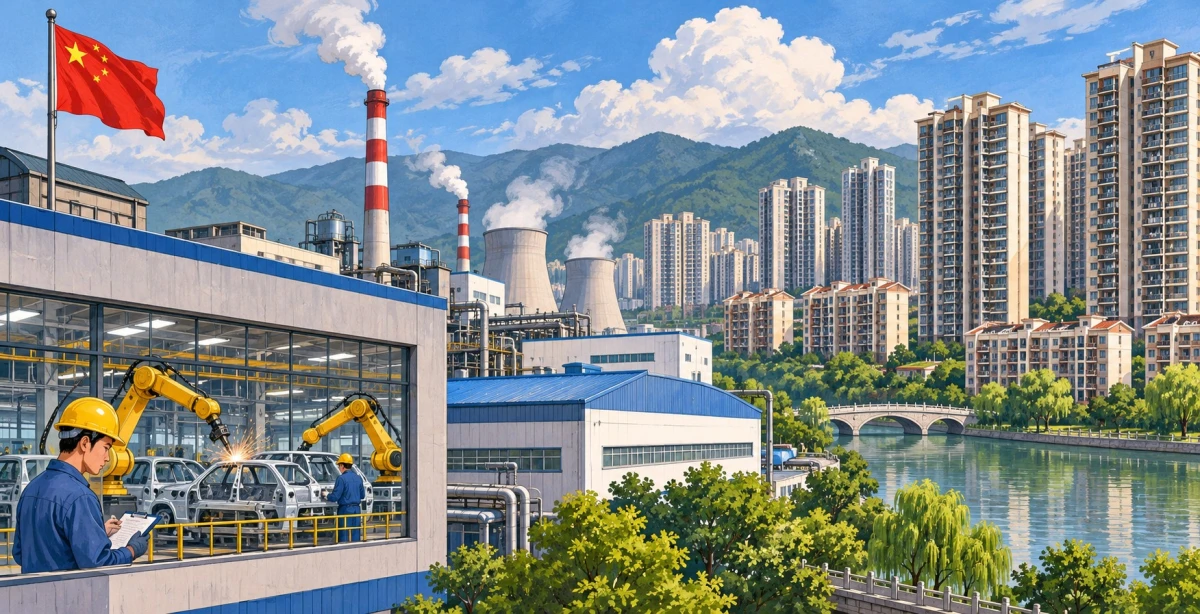
China's economy lost momentum at the start of the fourth quarter, with retail sales, industrial output and fixed-asset investment all coming in below economists' forecasts for October, according to data released by the National Bureau of Statistics on Monday, Nov. 16, 2026.
Retail sales of consumer goods rose 0.4% from a year earlier to 4.65 trillion yuan, slowing from 1.1% growth in September, which had been a six-month high. Economists had expected a 0.8% increase, CNBC reported. On a month-on-month basis, retail sales were essentially flat, rising 0.02%, the statistics bureau said.
Factory growth slows from a five-month high
Value added by industrial enterprises above a designated size grew 4.8% year on year in October, down from 5.5% in September and short of the 5.3% consensus forecast cited by CNBC. Manufacturing output rose 5.4%, while mining grew 0.7% and utilities 4.4%. For the first 10 months of the year, industrial output was up 5.3%.
Technology-related production continued to outpace the broader economy. High-tech manufacturing value added rose 17.6% and equipment manufacturing 10.6%, the bureau said, while output of 3D printing devices jumped 85.9%, lithium-ion batteries 30.0% and industrial robots 26.0%. By contrast, the bureau's Chinese-language release showed vehicle production fell 7.7% to 3.045 million units, even as new-energy vehicle output rose 17.1%. Steel output dropped 5.1% and crude oil processing fell 8.1%.
Investment slump deepens
Fixed-asset investment, excluding rural households, fell 8.1% in the January-to-October period to 36.48 trillion yuan, a steeper decline than the 7.2% drop recorded through September and worse than the 7.0% fall economists had forecast, according to ABN AMRO. CNBC described the contraction as unprecedented outside the Covid-19 period.
Real estate remained the largest drag. Property development investment dropped 21.6% in the first 10 months, while infrastructure investment fell 5.1% and manufacturing investment declined 2.9%. Private investment was down 11.4%. Sales of newly built commercial buildings fell 14.3% by value to 5.86 trillion yuan, and floor space sold dropped 13.7%, though online transactions of second-hand homes rose 11.4% by floor area, the bureau said.
Exports carry the economy
The weak domestic figures contrasted with strong trade. Goods exports rose 28.7% in yuan terms in October to 2.79 trillion yuan and imports climbed 34.7%, according to the statistics bureau. CNBC reported that China's trade surplus reached the $1 trillion mark by October, the fastest the country has ever hit that level, and that it is on course to exceed last year's record of about $1.2 trillion.
Consumer prices rose 0.7% from a year earlier in October, with core inflation, which strips out food and energy, at 0.8%. Producer prices climbed 5.7% year on year, faster than the previous month. The urban surveyed unemployment rate edged down to 5.1% from 5.2% in September.
In its statement, the bureau said the economy was "generally stable" but acknowledged that "the domestic imbalance between strong supply and weak demand is acute" and that some companies face operating difficulties.
What economists are saying
Zhiwei Zhang, president and chief economist at Pinpoint Asset Management, told CNBC that markets had already been worried about a slowdown in artificial intelligence spending, a key driver of Chinese exports, and that the risk "has become even more serious" following the leadership crisis at Nvidia. Citi Research analysts said further European Union trade measures targeting China look plausible, according to CNBC.
Goldman Sachs expects China's growth to slow to 4.6% this year from 5% in 2025 and to 4.5% in 2027, CNBC reported. ABN AMRO senior economist Arjen van Dijkhuizen wrote that Beijing's 2026 growth target of 4.5% to 5.0% likely remains within reach, with growth averaging 4.6% over the first three quarters, but that policymakers will need to do more to support growth in 2027. The bank expects further small policy rate cuts, lower bank reserve requirements and targeted fiscal support, with more guidance likely at the Central Economic Work Conference in December.
In markets, Shanghai's SSE Composite index ended Monday's session lower, while Hong Kong's Hang Seng index closed in positive territory, according to a Press Trust of India report carried by The Hindu.
What's Your Reaction?
 Like
0
 Dislike
0
 Love
0
 Funny
0
 Wow
0
 Sad
0
 Angry
0

Curated by iShook Opinion and guided by Founder and CEO Beni E Rachmanov. Dive into valuable financial insights at ishookfinance.com for expert articles and latest news on finance.















Comments (0)