
Fed's Waller Backs December Rate Hike and Says a Half-Point Move Should Be Considered if Core CPI Runs Hot
Fed Governor Christopher Waller said he leans toward a quarter-point hike in December and that 50 basis points should be considered if October core CPI rises 0.3% or more.
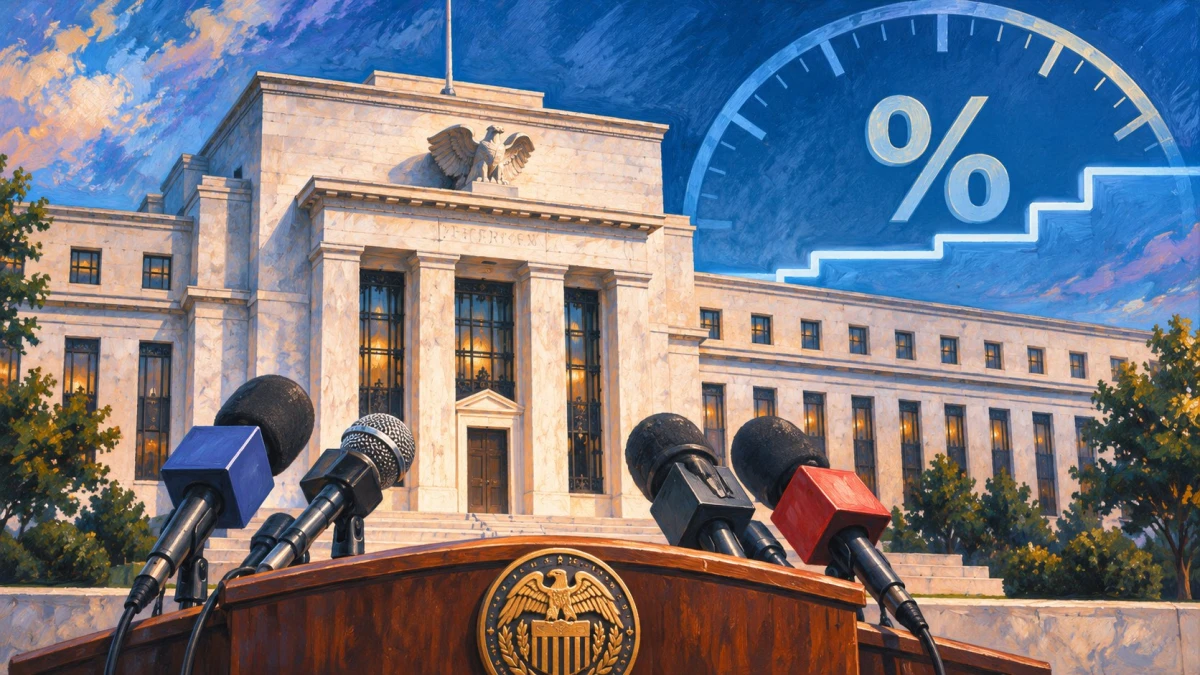
Federal Reserve Governor Christopher Waller said on Tuesday, Nov. 10, 2026, that he is leaning toward supporting a quarter-point increase in the central bank's policy rate at its December meeting even if October inflation data show improvement, and that a half-point move should be considered if the data come in hot. Waller made the remarks in a speech in London a few hours before the Labor Department was scheduled to publish the October consumer price index at 8:30 a.m. ET.
What Waller said
In prepared remarks titled "The Economic Outlook and Some Thoughts on Labor Market Dynamism," published by the Federal Reserve Board, Waller described a U.S. economy that is growing strongly, with employment close to its long-term rate, while inflation remains too high. He said he believes further tightening will be needed "sooner rather than later" to put inflation on a path back to the Fed's 2% goal over the medium term.
Waller said that while he hopes the October CPI will show an improvement over September, he would still support a 25-basis-point increase in December if that happens. If core CPI inflation instead comes in around 0.3% for the month or higher, similar to the two prior monthly readings, he said a stronger move may be needed. "In that case, I believe a 50 basis point hike in the policy rate should be considered at the December meeting," he said. "Hiking only 25 basis points would put our credibility at risk, a risk I am not eager to take."
The governor also explained why he backed the decision to hold rates steady at the Federal Open Market Committee's October meeting. He said the committee's communication about likely tightening had already led financial markets to price in higher rates, and that what matters is that promised increases are eventually delivered rather than taken at consecutive meetings. If the hikes are not carried out, he said, markets would scale back expectations and rates would fall, loosening policy in an undesirable way.
The inflation picture he described
Waller was blunt about the latest data. He said September's inflation figures were bad, with "no silver lining." Personal consumption expenditures prices, the Fed's preferred gauge, rose 0.5% in September and 3.7% over the prior 12 months, he said. Core PCE, which excludes food and energy, rose 0.3% on the month and 3.1% from a year earlier.
He said he is particularly concerned about how broad the price increases have become. Earlier in the year, he said, excess inflation was driven largely by nonmarket prices that are estimated rather than observed. Now, core goods prices and core market-based services excluding housing are elevated, and more than 70% of the components of core PCE services prices showed 12-month increases above 3% in September.
According to Reuters, via Investing.com, Waller said he would be watching the October report for whether that breadth continues, including whether prices of high-tech goods tied to the artificial intelligence buildout keep rising at the very high rates of recent months, and whether higher energy costs are passing through to other goods and services. He cited recent Fed staff analysis suggesting energy shocks may now push prices up more persistently than before the pandemic, and that, especially if oil prices stay elevated, those pressures could persist well into 2027.
Market expectations and the CPI release
Reuters reported that, as of Monday's close, futures tied to the Fed's policy rate priced roughly an 85% chance of a rate increase at the Dec. 8-9 meeting, which would lift the target range to 4.00%-4.25%, along with a better-than-even chance of another increase as soon as March. Economists polled by Reuters expected core CPI to rise 0.2% in October from September.
CNBC reported that economists surveyed by Dow Jones expected headline CPI to rise 0.3% and core CPI to rise 0.2% from the prior month. CNBC also noted that Waller said higher rates "will be needed, sooner rather than later," and that the timing of individual increases matters less than following through within a reasonable period.
U.S. stock index futures were mixed early Tuesday as investors awaited the inflation report. CNBC said S&P 500 futures were up about 0.1% and Dow futures were up 177 points, or 0.3%, while Nasdaq-100 futures slipped 0.2%. On Monday, the Dow rose 1,104 points, or 2.2%, the S&P 500 gained about 2.4% and the Nasdaq Composite climbed 2.7%, following a volatile prior week.
Oil prices in the background
Energy costs have been a central part of the inflation debate this year. Reuters, in a markets report carried by Euronext, said Brent crude futures fell more than 2% on Tuesday and dipped below $90 a barrel for the first time since late August after President Donald Trump said he plans to hold off on new military strikes against Iran. The report said inflation concerns have been on investors' radar since the U.S.-Israeli war with Iran began at the end of February.
The Fed raised rates in September for the first time in three years and held its policy rate steady at its October meeting. Its next scheduled decision is due at the conclusion of the Dec. 8-9 meeting.
What's Your Reaction?
 Like
0
 Dislike
0
 Love
0
 Funny
0
 Wow
0
 Sad
0
 Angry
0

Curated by iShook Opinion and guided by Founder and CEO Beni E Rachmanov. Dive into valuable financial insights at ishookfinance.com for expert articles and latest news on finance.













Comments (0)