U.S. Consumer Sentiment Finalized at 48.0 in October as Inflation Expectations Climb to 4.7%
The University of Michigan's final October reading put sentiment at 48.0, revised up from 46.3, as year-ahead inflation expectations rose to 4.7% and durable-goods buying conditions fell 18%.
U.S. consumer sentiment was essentially unchanged in October, but Americans' expectations for inflation rose for a second straight month and their view of current buying conditions deteriorated sharply, according to the final October results of the University of Michigan Surveys of Consumers released on Friday, October 23, 2026.
Headline index revised higher, still below September
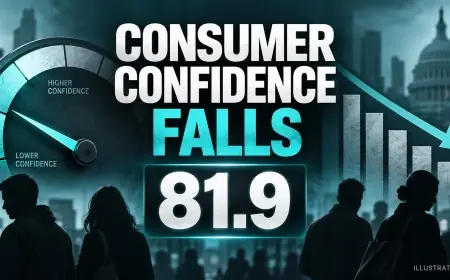
The Index of Consumer Sentiment came in at 48.0, compared with 48.1 in September and 53.6 in October 2025, the survey's final results table shows. That is a month-over-month decline of 0.2% and a year-over-year drop of 10.4%. The final figure was revised up from a preliminary October reading of 46.3, which was also what economists had expected for the final number, Investing.com reported. The outlet noted that the reading was the second-lowest on record, above only the 44.8 recorded in May.
The survey's two components moved in opposite directions. The Current Economic Conditions index fell 8.3% to 46.7 from 50.9 in September, and was 20.3% below its year-earlier level of 58.6. The Index of Consumer Expectations rose 5.4% to 48.8 from 46.3, though it remained 3.0% below the 50.3 reading of October 2025. The university says a monthly change of at least 4.8 points is needed for the headline index to be statistically significant at the 95% level, and 6 points for each of the two sub-indexes.
"Consumer sentiment held steady this month, registering a scant one-tenth of an index point below September," survey director Joanne Hsu wrote. She said increases in sentiment among Republicans and Democrats were offset by declines among independents, and that year-ahead business conditions improved about 14% but stood 16% below last October's level.
Interest rates hit big-ticket purchases
The drop in the current-conditions gauge was driven entirely by buying conditions for durable goods, which plunged 18% "on the basis of higher interest rates and rising concerns about the affordability of such purchases," Hsu said in the university's news release.
Homebuying conditions plummeted, with 85% of consumers saying it is a bad time to buy a house. About 62% of respondents blamed high interest rates, up from 47% in September, while 42% cited prices, down from 47% two months earlier. In auto buying conditions, mentions of interest rates increased to 24% from 18% in September. About 69% of consumers expect interest rates to rise over the next year, the highest share since April 2023, according to the release.
Inflation expectations at highest since May
Year-ahead inflation expectations ticked up to 4.7% from 4.6% in September, well above the 3.4% recorded in February before the Iran conflict began and above all 2024 readings, Hsu said. Long-run inflation expectations rose to 3.5% from 3.4%, compared with a 2024 range of 2.8% to 3.2%. Both measures increased for a second consecutive month to their highest readings since May. Investing.com noted that both inflation-expectation figures were unchanged from the preliminary October estimates. The university also published a special report on the same day examining long-run inflation expectations in historical context.
Price pressures weigh on lower-wealth households
The share of consumers who spontaneously said high prices were hurting their personal finances rose for a fourth straight month to 56%, compared with 45% in January. "Purchasing power continues to dominate consumer views of the economy," Hsu said, adding that sentiment is 10% below a year ago and 15% below February.
The increase in price complaints was seen across the political spectrum, with Republicans showing the largest proportional rise, and among consumers with no stock holdings or very small holdings, according to the release. Consumers with the largest stock holdings reported little change in the burden of high prices since February. Gasoline prices were mentioned unprompted by more than 40% of respondents.
What comes next
The data arrive days before the Federal Reserve's October 27-28 policy meeting, with the rate decision scheduled for October 28. The next preliminary University of Michigan sentiment report is scheduled for November 6 at 10 a.m. ET, according to Investing.com.
Sources
- University of Michigan Surveys of Consumers: Final Results for October 2026 (Oct. 23, 2026)
- Michigan News: As concerns over purchasing power dominate, consumer sentiment moves sideways (Oct. 23, 2026)
- Investing.com: US Consumer Sentiment Revised Up to 48.0 as Inflation Expectations Rise (Oct. 23, 2026)
What's Your Reaction?
 Like
0
 Dislike
0
 Love
0
 Funny
0
 Wow
0
 Sad
0
 Angry
0

Curated by iShook Opinion and guided by Founder and CEO Beni E Rachmanov. Dive into valuable financial insights at ishookfinance.com for expert articles and latest news on finance.
















Comments (0)